

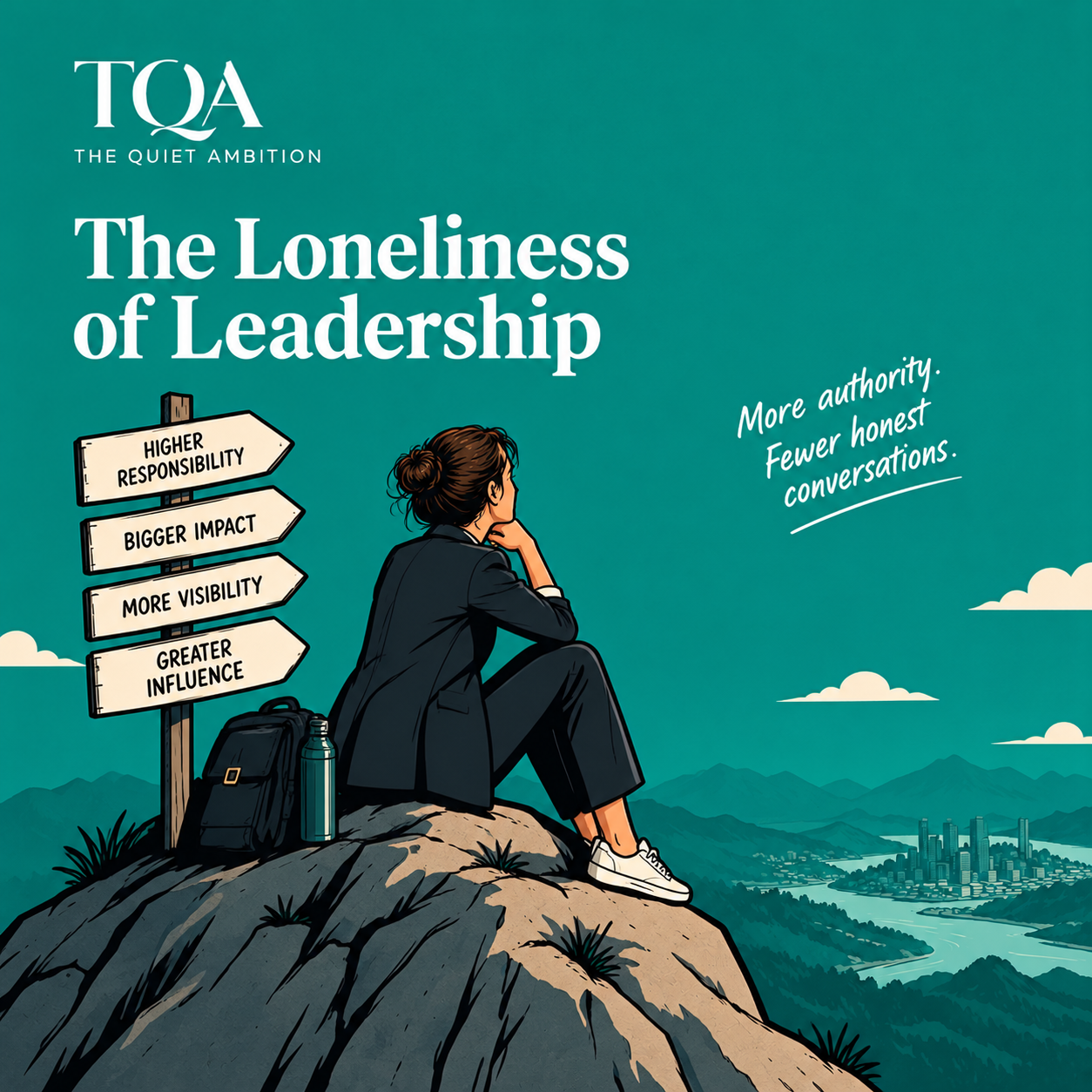
The Loneliness of Leadership. Issue #11
Season Two: The Architecture of Freedom
Act I — Reckoning
The Quiet Story
For years, the story looked like nothing but momentum. A small idea, built with friends in a San Francisco apartment, grew into a company that reshaped how the world thinks about travel. By every visible measure, the climb was extraordinary. What wasn't visible was what the climb was quietly costing.
Airbnb's Brian Chesky has since admitted that his relationship with work, in the years the company scaled, had the shape of an addiction, one that went unquestioned for a long time because it looked like dedication rather than something to be concerned about. He gave everything he had to the company. What he didn't notice, until much later, was what he'd stopped giving to everyone else. Weeks would pass without a call to his sister. High school friends went twenty years without a single conversation, not through any falling out, but simply because he never found — or made — the time.
He has since said that arriving at the top taught him something he wishes someone had told him at the start: that he had carried most of what he needed inside himself before the climb ever began, and that what he'd actually been missing wasn't altitude. It was purpose, health, and the relationships he'd let go quiet.
This is rarely how the loneliness of leadership gets discussed.
We imagine it as something dramatic a boardroom betrayal, a public fall, a moment where the walls visibly close in. More often, it looks like Chesky's version: a slow erosion of the people who once told you the truth without being asked, replaced by nothing in particular, because nobody sets out to lose their honest circle. It simply stops being replenished.
Carol Tomé, the first woman to lead UPS in its 117-year history, was warned before she took the role that it would be lonely. She didn't quite believe it , until she was in the seat herself, and noticed that the executive team she used to belong to now waited for her to leave the room before they debriefed honestly with one another. She hadn't done anything to cause that shift. The title had done it for her.
Apple's Tim Cook has drawn a distinction worth sitting with: that the issue for people at his level isn't really loneliness in the way we usually picture it. It's isolation, a narrowing of who reaches you with the unfiltered version of things, long before the feeling of being alone ever sets in. By the time the loneliness is felt, the isolation has usually been underway for years.
Three different leaders, three different industries, the same architecture underneath: the seat itself rearranges who tells you the truth, and it does this quietly enough that most people don't notice until the room has already gone still.
Barack Obama has said something similar about the presidency, describing a "weird isolation" that set in as he adjusted to the role, advice and counsel still arrived, but the decision, in the end, was always his alone to carry.
Different arena, same architecture. The higher the office, the more the room organises itself around your solitude, and the less anyone tells you that's what's happening.
The Insight
Leadership doesn't create loneliness by accident. It manufactures it, quietly and by design, every time someone decides that honesty is a risk they can no longer afford to receive.
The Quiet Disconnect
We tell ourselves the isolation is the price of the seat, inevitable, almost noble, the cost every serious leader eventually pays. What we don't say out loud is that we participated in building the walls ourselves. Every time we punished a hard truth with a cold reaction, every time we rewarded agreement over challenge, every time we let a friendship go quiet because the calendar was full, we taught the people around us what was safe to bring us, and what wasn't worth the risk. The silence that now surrounds us wasn't something that happened to us. It's something we trained, one small withdrawal at a time.
The Quiet Choice
The choice at the top is rarely between loneliness and connection. It's between the comfort of being agreed with and the risk of being told something true, and most of us, without quite deciding to, keep choosing comfort.
The Quiet Rebellion
Rebuilding an honest circle means deliberately inviting the discomfort back in. It means asking the question you don't want the answer to. It means keeping at least one relationship in your life where your title buys you nothing, no deference, no careful phrasing, no managed version of the truth.
The Quiet Beginning
It starts with a single conversation where you ask someone to tell you the truth, and then this is the hard part you don't punish them for it. Not with your face, not with your silence afterward, not with quiet distance in the weeks that follow.
The Quiet Ambition Exercise
Name one person in your life who still tells you what you don't want to hear. If no one comes to mind, that's the starting point, not a failure. Write down what it would take to become someone they'd trust with that kind of honesty again, and who, in your own life, has gone quiet the way Chesky's sister did, simply because you stopped making the time.
The Quiet Mantra
I would rather be corrected than comfortable.
The Quiet Reflection
Think back to the last time someone disagreed with you at work or at home. What did your reaction, even the smallest flicker of it, teach them about whether it was worth doing again?
The Quiet Conversation
When did you first notice your honest circle getting smaller and what, if anything, have you done to rebuild it? Share in the comments; this issue opens a season about the architecture we build around our own freedom, and it starts with who we let close enough to tell us the truth.
---
Until next time,
Stay ambitious. Stay intentional.
With love, Caroline H. Founder #TheQuietAmbition #TQA
If this landed somewhere deep and you're ready to do the real work, I have a limited number of coaching and workshops spots open this month → Book a complimentary 30-minute Clarity Call [link in comments]. No pressure. Just conversation, insight, and clarity.
#TheQuietChoice : Don't React to Every Opportunity. Create space to hear yourself think.
#TheQuietConversation : Every issue ends here, but the conversation doesn't have to my inbox is always open…. get in touch.
#TheQuietCircle : Come join our community share ideas, ask questions and explore.
[links in comments]
© 2026 All rights reserved. No part of this newsletter may be reproduced, distributed, or transmitted without prior written permission from #TQA or The Quiet Ambition via Author Caroline H. at The Quiet Ambition @quietambitionhq | Building a life that leads to more life and Clarity & Alignment | The Quiet Ambition Practice @quietambitionhq
➕Follow Caroline H. for more insights.
© The Quiet Ambition · 2026