The Rest Resistance. Issue #17
Season Two: The Architecture of Freedom
Act II — Reconstruction
Rest feels like falling behind because stillness was never modelled as productive.
The Quiet Story
In 2008, Lin-Manuel Miranda took his first holiday from In the Heights, a show he had spent 7 years bringing to Broadway. It had worked. So he went to a resort in Mexico, and for something to read by the pool he picked up Ron Chernow's biography of Alexander Hamilton, all 818 pages of it. A few chapters in, he could already see it as a musical.
He later described the moment to Arianna Huffington in a single sentence: "The moment my brain got a moment's rest, Hamilton walked into it." He added that it was no accident the best idea of his life had arrived on holiday.
There is a song in the show he went on to write called "Take a Break". In it, his Hamilton is urged to come away with his family for the summer, and he refuses. He stays behind in the city to finish his plan, exhausted and alone, and the decision he makes during that summer is the one that unravels his future. The man who wrote a musical about someone who could not stop was only able to write it because he did.
Most of us would have spent that week in Mexico differently, the laptop open on the sun lounger, one eye on the inbox, a quick call to stay across things, and underneath it all a quiet sense of being responsible. ..We would have come home tired, slightly sunburnt, with nothing new in our heads, and we would have called it dedication. If the most celebrated musical of a generation began on a holiday, why does a holiday feel, to so many capable people, like the first step towards falling behind?
The Insight
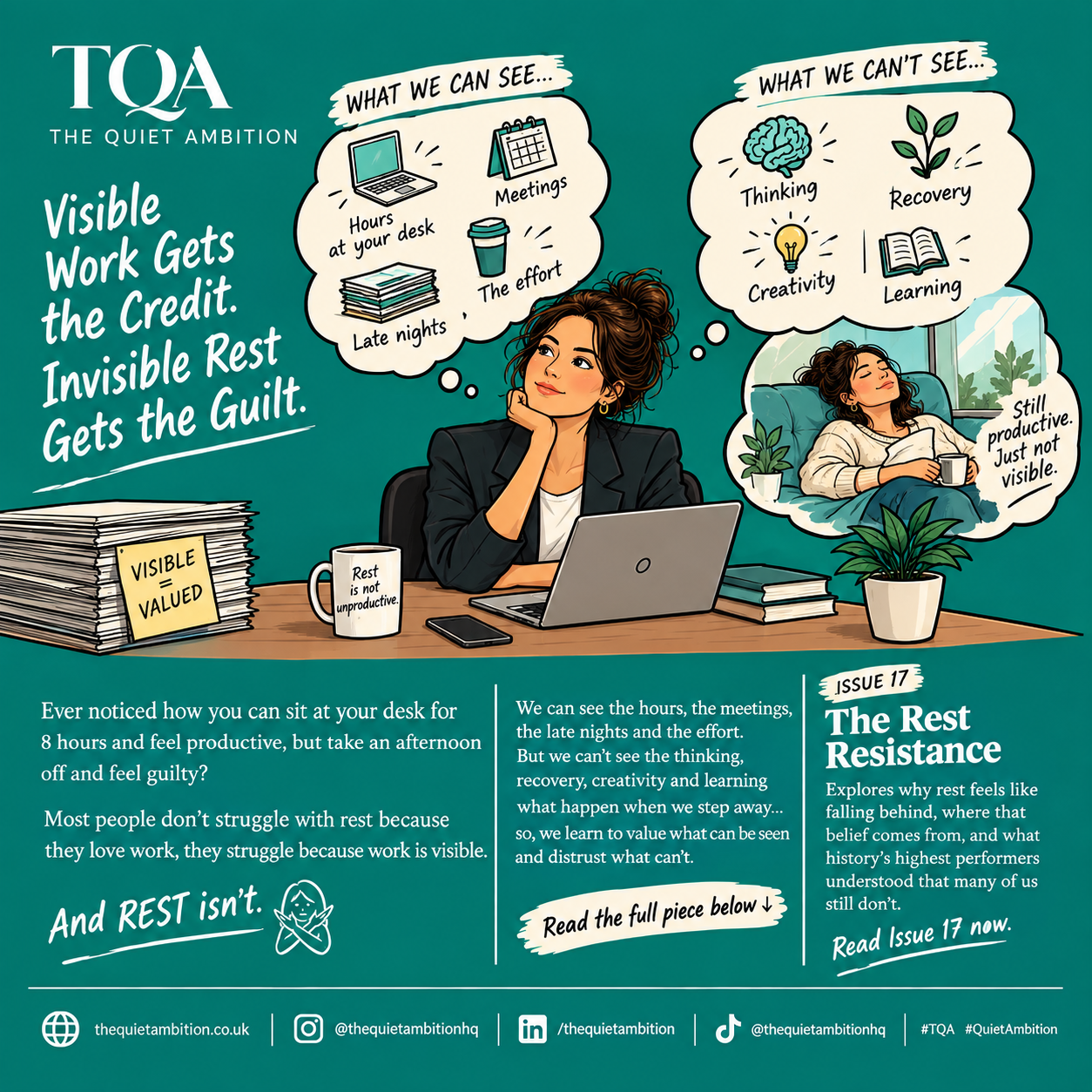
We learned what work looks like by watching it. That is how most of us learned most things, from what the adults around us did with their time rather than from what they said they valued. Think about what you saw; a parent who never sat down, or who only sat down when they were ill, teachers who praised the pupil who looked busiest, a first manager who was already at their desk when you arrived and still there when you left, a senior partner whose lit office at 10 at night told everyone on the floor what commitment looked like.
None of them could have shown you the work that happens in stillness, even if they had wanted to, because that work cannot be seen. You can watch someone type. You cannot watch a mind consolidate a skill, connect two ideas that have never met, or quietly settle what matters. So the model most of us absorbed has a hole in exactly the place where some of the most important work happens.
What grows in that hole is something I call The Visibility Ledger: the internal account most ambitious people keep without ever deciding to, a running record that credits only effort someone else could have witnessed. Hours logged, emails answered, rooms entered, decks delivered, the name on the late-night reply. Anything that happens inside you, in the quiet, never makes it onto the page. So rest can only ever be entered as a withdrawal, an hour spent with nothing to show for it, and the balance always looks as if it is falling.
The ledger is wrong, and we now know roughly how wrong. In a 2019 study at the US National Institutes of Health, volunteers learning a new typing sequence made most of their gains during short rest breaks rather than while they were typing. A follow-up in 2021 showed what was happening in those breaks: the brain was replaying the sequence at around twenty times the speed, again and again, and the people whose brains replayed it most improved most. The senior scientist, Leonardo Cohen, concluded that wakeful rest plays as important a role as practice in learning a new skill. The learning was happening in the gap.
The same finding sits, mostly ignored, inside the study that gave the world the "10,000-hour rule". When Anders Ericsson and his colleagues studied violinists at the Music Academy of West Berlin, published in 1993, the best students had practised more. They had also slept more, around eight and a half hours a night, and taken afternoon naps that added up to nearly 3 hours a week, against less than an hour for the least accomplished group. The violinists themselves rated sleep among the most important things they did to improve. The hours became a slogan. The naps never made the poster.
Neuroscience even has a name for what the mind does when it stops pushing outward. The default mode network is a set of brain regions that becomes more active when attention turns inward, and a 2012 review led by Mary Helen Immordino-Yang linked it to recalling our own past, imagining the future, understanding other people and moral reasoning. The review's title was Rest Is Not Idleness.
So the unease that arrives when you stop tells you nothing about your progress. It is the ledger registering an entry it has no column for. The Rest Resistance is the alarm that goes off when you stop, and most of us have spent years mistaking it for conscience.
The Quiet Disconnect
Ask almost any ambitious professional whether rest matters and they will say yes, quickly, the way you agree with something you once read. Ask when they last rested without first justifying it to themselves and the answer takes longer.
Part of the reason is that the fear has a basis. In 2015 the organisational researcher Erin Reid published a study of an elite strategy consulting firm, built on interviews with 82 consultants and access to their performance reviews. The firm's ideal was the consultant who was always available and routinely worked 60 to 80 hours a week. Some men had quietly stepped off that treadmill: they worked nearer 50 or 60 hours, kept their clients local to cut travel, and simply never mentioned it. Their reviews were as glowing as those of the people genuinely working the longest hours, and they were promoted alongside them.
The people who were marginalised were those who asked openly for time, and most of them were women. The firm could not tell the difference between devotion and a convincing performance of it. What it penalised was rest that could be seen.
That distinction explains a great deal. The alarm you feel when you stop was installed in rooms where visible rest really did cost something. The cost was attached to being seen, never to the rest itself. And other people's eyes carry more weight than we admit.
In 2017, Silvia Bellezza and her colleagues found that Americans read a busy, overworked life as a mark of status, a signal that someone is competent, ambitious and in demand, while Italians in the same studies still read a leisurely life as the higher-status one.
Busyness as a badge is a cultural setting, which means it was learned.
In the UK the pattern has its own vocabulary. The CIPD's 2023 health and wellbeing survey found presenteeism, working while unwell, in 87% of organisations, and leaveism, working through annual leave or outside contracted hours, in 63%. The more telling finding sat in the accompanying survey of workers, which suggested that the pressure to keep working while unwell often came from within rather than from managers or colleagues. The supervisor has moved inside.
Left alone with nothing to account for, the ledger panics. In a 2014 study published in Science, researchers asked people to sit alone with their thoughts for fifteen minutes, beside a button that delivered a mild electric shock they had earlier said they would pay to avoid. Two-thirds of the men and a quarter of the women pressed it at least once.
Meanwhile we tell ourselves rest is a reward we will collect once the work is done. Ambitious work is never done; that is part of what makes it ambitious. So the reward is deferred indefinitely, and the only rest that reliably arrives is the kind the body takes by force: the cold that lands on the first day of the holiday, the weekend lost to exhaustion, the burnout that finally makes the decision for you.
Rest you have to earn arrives as collapse.
The Quiet Rebellion
Tricia Hersey grew up watching something most of us never saw. Her grandmother, Ora, raised 8 children and worked 2 jobs, and every day, in between them, she sat on the couch in silence with her eyes closed for half an hour or more. When the young Tricia asked whether she was asleep, her grandmother answered without opening her eyes: "Every shut eye ain't sleep." She was resting, she said. She was listening.
Having that model did not make Hersey immune. Around 2014, bone-tired at seminary, she decided to slow down even if it meant failing out of school. She didn't fail. In 2016 she founded The Nap Ministry, and in 2022 she published Rest Is Resistance, which argues that grind culture treats human bodies as machines and that rest is a way of refusing it. She ties that culture to capitalism and white supremacy, and to a history in which some bodies were valued only for what they could produce. She calls her grandmother the muse of the work. What Ora gave her was a memory she could find her way back to.
Her title and this issue's title are mirror images. She argues that rest is resistance. This issue is about the rest resistance, the reflex in us that fights stopping. The distance between those two phrases is often the distance between someone who once saw rest modelled and someone who never did.
Maya Angelou built a practice of her own and wrote it down. In an essay called "A Day Away", published in Wouldn't Take Nothing for My Journey Now in 1993, her opening line is an instruction with no hedge in it: "Every person needs to take one day away." She prepared the night before as if for an escape, then spent the day wandering with nothing to fix. Her reasoning goes straight at the fear. Our jobs, families, employers and friends can manage a day without any one of us, she wrote, and could manage without us altogether, if our egos would let us admit it. She knew stepping away would look irresponsible to some people; she saw it as preparation for doing her duties better. And she noticed that when she came home, questions she had been avoiding had often answered themselves and tangles she had dreaded had loosened in her absence.
Neither woman argued that rest makes you more productive. They refused to let productivity be the only thing that grants permission, and they kept the practice whether or not anyone could see it. That refusal is the rebellion.
The Quiet Beginning
Reconstruction rarely begins with a feeling. More often it begins with a structure that makes the feeling unnecessary.
In 1842, when John Lubbock was eight years old, a new neighbour moved into Down House, near his family's home in Kent. The neighbour was Charles Darwin, a man who walked the same gravel path around his garden every day to think, and who became Lubbock's friend and mentor. Lubbock grew up to be a banker, a Liberal MP and a scientist in his own right, and in 1871 he steered the Bank Holidays Act through Parliament. It created the first secular public holidays in Britain, and people were so grateful that they nicknamed them St Lubbock's Days. In law, the Act did something narrower than hand anyone a day off. It shut the counting-houses, and much of the country followed.
In 1894 he wrote a sentence whose first four words would later title that 2012 neuroscience review: "Rest is not idleness, and to lie sometimes on the grass under the trees on a summer's day, listening to the murmur of water, or watching the clouds float across the blue sky, is by no means waste of time."
He was not a pure radical about it. Elsewhere in his writing Lubbock insisted that the idle man cannot enjoy rest because he has not earned it. The earning clause runs deep, even in the man who gave Britain its bank holidays. His legislation was wiser than his maxim. He did not wait for the workers of Victorian Britain to feel they had earned a day off; he put the day in the calendar, where it would arrive whether or not anyone felt ready.
That is where reconstruction begins for most of us too. You will not argue The Visibility Ledger into silence. It has decades of evidence on its side, much of it gathered in rooms that really did reward the visible.
What you can do is close it at set times, the way Lubbock closed the counting-houses. Rest that does not have to be earned has to be scheduled.
The Quiet Ambition Exercise: The Ledger Audit
1. Trace the inheritance. Write down, without editing, how rest looked in the home you grew up in. Who sat down, and when? What was it called: laziness, illness, a treat, something earned? And whose rest was invisible, because they took it when nobody was watching or never took it at all?
2. Catch the first sentence. The next time you stop for twenty minutes, with no phone and no task, notice the first sentence your mind produces and write it down word for word. "You should be…" "Everyone else is…" "Just check…" That sentence is the ledger speaking. Ask whose voice it borrowed.
3. Book one unearned hour. Put a block in your diary this week that is rest before you are tired rather than after. Give it no productive justification. Treat it like a bank holiday: it happens whether or not you feel you have earned it. Afterwards, note anything that moved while you weren't pushing it, and notice whether the hour was worth having even if nothing did.
The Quiet Mantra
Unseen is not undone. I don't have to earn the pause.
The Quiet Reflection
Aristotle held the opposite view to the one most of us inherited. "We are busy that we may have leisure," he wrote in the Nicomachean Ethics, treating work as the means and leisure as the point. The languages carried the same assumption. The Greek word for leisure, scholē, is the root of our word school, because leisure was where learning happened. The Latin for business, negotium, was built as a negative, nec otium, not-leisure, and it gave us the word negotiate. For centuries, work was defined as the absence of rest. We now call rest time off, as though work were the real thing and everything else a gap in it.
What was inherited can be changed. Bali still stops for a day each year for Nyepi, the Day of Silence. One of its four observances is amati karya, no work. Lights go off, roads empty and Ngurah Rai International Airport suspends every flight for twenty-four hours. A whole island models stillness in public, once a year, and the world carries on.
For many ambitious people the resistance goes deeper than habit. If your worth has been measured for years in visible output, stillness removes the evidence, and the quiet feels less like rest than like disappearing. That is The Identity Debt from Season One, still collecting interest and "falling behind" assumes a race, with other people's visible busyness setting the pace you are failing to match: the Comparison Tax, paid in hours. Neither yields to argument. The ledger does not need you to believe in it. It only needs you to keep feeding it.
The Quiet Shift
It would be easy to end with the familiar advice to rest because rest makes you more productive. The research suggests that will not be enough. In studies published in 2021, Gabriela Tonietto, Selin Malkoc and colleagues found that people who see leisure as wasteful enjoy it less and report more stress, anxiety and depression. When the researchers nudged people to see leisure as wasteful, their enjoyment fell. When they nudged them to see it as productive, enjoyment did not rise. Telling yourself that rest is useful leaves the ledger in charge; it simply hands it a new entry to audit.
So the shift this issue asks for, concerns authority more than argument. For most of your working life, the ledger decided what counted, and it only counted what could be witnessed. The shift is deciding for yourself that some things count without a witness: the idea that arrives on the sun lounger, the skill that settles during the pause, the day away from which you come back to find the knot already untied.
Some of what happens in the quiet will be useful, some of it will simply be yours and both count. Rest stops being a reward collected at the end and becomes part of the rhythm of the work, built in at set times like Lubbock's holidays, so that it no longer depends on how you feel about it.
The Quiet Choice
The choice in front of you sits between two ledgers. You can keep the one you inherited, which credits only what others can witness, and go on paying for it the way it has always been paid for: in holidays spent half-present, in illnesses that make the decision for you, in the slow wearing away of the part of your mind that only works when it is left alone. Or you can begin keeping a second ledger alongside it, where unseen hours count, and close the first at set times whether or not the alarm goes off.
The alarm will go off for a while, rest will still feel like falling behind, because a feeling installed over decades does not leave on request. Feelings like this tend to follow a decision rather than precede it and if the hardest part of resting turns out to be that nobody will ever see it, stay with that discomfort for a week. Next week's question begins exactly there.
The Quiet Conversation
I'd love to hear from you in the comments. What did rest look like in the house you grew up in, and who, if anyone, modelled it well? What is the first sentence your mind produces when you stop? And which would be harder for you: a full day with no work, or a full day of work that no one would ever see?
The Quiet Circle
The Quiet Ambition Circle is our private LinkedIn Group, a space for professionals to think, question and grow, away from the performance of the public feed. The door stays open. You don't need to arrive with anything polished: bring the first sentence from your Ledger Audit and we'll start there. [Join The Quiet Ambition Circle: link]
♻️ If someone in your world only rests when they collapse, send this their way.
🔔 Follow The Quiet Ambition for more on ambition, on your own terms.
Want to read your own ledger with someone trained to spot what it leaves out? Book a 30-minute Spark Session, or join me for The Ambition Audit: 90 minutes to find out whether you're chasing what you actually want, live on Zoom on 2, 6, 7 and 9 November, with 12 places per session. [Book a Spark Session: link in comments] · [Reserve your Ambition Audit place: link in comments]
NEXT WEEK: The Legacy Question
Act III — Mastery opens. Would you still build this if no one ever knew?
Most people think legacy is what others remember about them. It is closer to what you would keep building if nobody ever found out.
We'll explore:
Why the need to be witnessed quietly shapes what ambitious people choose to build. The gap between a reputation and a legacy. What changes when the only audience left is you. A simple test for whether your ambition would survive.
Until next time,
Stay ambitious. Stay intentional.
With love, Caroline H. Founder #TheQuietAmbition #TQA
If this landed somewhere deep and you're ready to do the real work, I have a limited number of coaching and workshops spots open this month → Book a complimentary 30-minute Clarity Call [link in comments]. No pressure. Just conversation, insight, and clarity.
#TheQuietChoice : Don't React to Every Opportunity. Create space to hear yourself think.
#TheQuietConversation : Every issue ends here, but the conversation doesn't have to my inbox is always open…. get in touch.
#TheQuietCircle : Come join our community share ideas, ask questions and explore.
[links in comments]
© 2026 All rights reserved. No part of this newsletter may be reproduced, distributed, or transmitted without prior written permission from #TQA or The Quiet Ambition via Author Caroline H. at The Quiet Ambition @quietambitionhq | Building a life that leads to more life and Clarity & Alignment | The Quiet Ambition Practice @quietambitionhq
➕Follow Caroline H. for more insights.
© The Quiet Ambition 2026 · thequietambition.co.uk
Source:
- Miranda, HuffPost (2016): https://www.huffpost.com/entry/lin-manuel-miranda-says-its-no-accident-hamilton-inspiration-struck-on-vacation_n_576c136ee4b0b489bb0ca7c2
- Hamilton timeline (Mexico holiday, 818-page biography): https://www.newyorktheatreguide.com/theatre-news/news/a-timeline-of-hamilton-on-broadway-and-beyond
- NIH press release (2021 replay study, 2019 background): https://www.nih.gov/news-events/news-releases/study-shows-how-taking-short-breaks-may-help-our-brains-learn-new-skills
- NIH Research Matters: https://www.nih.gov/news-events/nih-research-matters/how-short-breaks-help-brain-learn-new-skills
- Ericsson et al. (1993), via the 2019 replication: https://www.ncbi.nlm.nih.gov/pmc/articles/PMC6731745/
- Violinists' sleep and naps (summary): https://www.psychologytoday.com/us/blog/aspire-perspire-repeat/201309/unlikely-study-strategy-for-the-gre-lsat-mcat-sat-nap
- Immordino-Yang et al. (2012): https://journals.sagepub.com/doi/abs/10.1177/1745691612447308
- Reid, HBR (2015): https://hbr.org/2015/04/why-some-men-pretend-to-work-80-hour-weeks
- Reid, BU Bostonia (82 consultants, reviews): https://www.bu.edu/bostonia/2015/how-some-men-in-business-pass-as-ideal-workers
- Bellezza et al. (2017), Columbia release: https://business.columbia.edu/press-releases/cbs-press-releases/lack-leisure-busyness-new-status-symbol
- CIPD Health and wellbeing at work (2023): https://peopleprofession.cipd.org/globalassets/media/knowledge/knowledge-hub/reports/2023-pdfs/8436-health-and-wellbeing-report-2023.pdf
- CIPD 2023 summary incl. worker survey: https://mfmac.com/insights/employment/sickness-absence-rates-at-highest-level-for-10-years
- Wilson et al. (2014), BPS Research Digest: https://bps.org.uk/research-digest/it-darkness-within-some-people-would-rather-shock-themselves-electricity-spend-time
- Hersey, Greater Good podcast (Grandma Ora): https://greatergood.berkeley.edu/podcasts/item/tricia_hersey_silence_nap_ministry
- Hersey, Emory (seminary, 2014): https://news.emory.edu/features/2023/07/emag-power-of-naps-13-07-23/index.html
- Hersey, Cornell lecture (30–60 minutes daily): https://scl.cornell.edu/news-events/news/hersey-ties-rest-liberation-2026-mlk-commemorative-lecture
- Angelou, "A Day Away" (check against the book): https://www.goodreads.com/work/quotes/741834-wouldn-t-take-nothing-for-my-journey-now
- Lubbock, Royal Society: https://royalsociety.org/blog/2021/04/st-lubbocks-days/
- Lubbock, NatWest Heritage: https://www.natwestgroup.com/heritage/people/john-lubbock.html
- Lubbock quote (The Use of Life, 1894): https://libquotes.com/john-lubbock/quote/lbm2d2c
- Tonietto et al. (2021): https://business.rutgers.edu/sites/default/files/documents/tonietto-viewing-leisure-as-wasteful-undermines-enjoyment.pdf
- Pieper, scholē and negotium (The New Criterion): https://newcriterion.com/article/josef-pieper-leisure-and-its-discontents/
- Nyepi (airport closure, amati karya): https://www.hinduismtoday.com/hpi/2022/03/01/the-dos-and-donts-of-nyepi-day-in-bali/