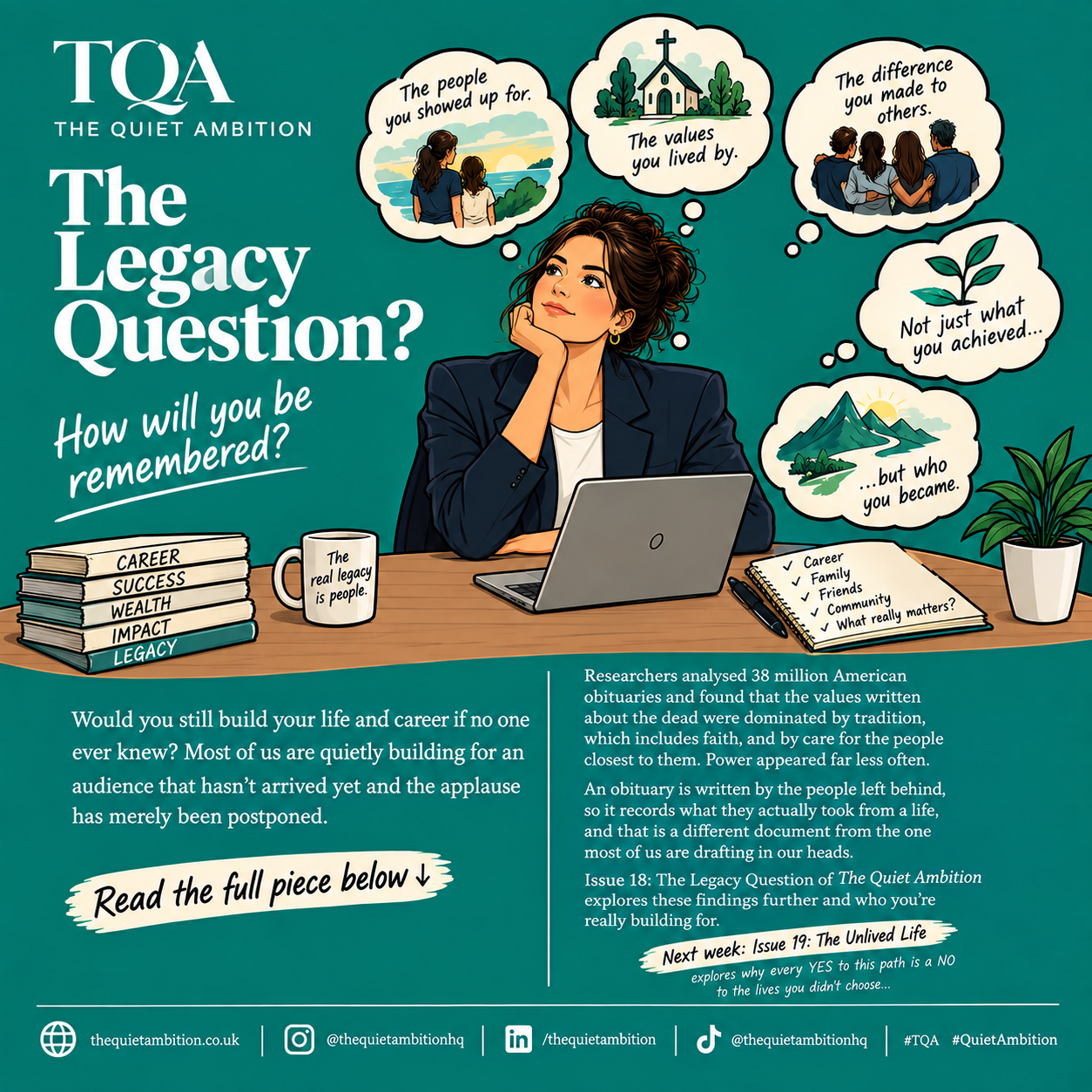
The Legacy Question? Issue #18
Season Two: The Architecture of Freedom |
Act III — Mastery
Would you still build this if no one ever knew?
The Quiet Story
In 1996, two men in Cape Town set out to find out how a musician had died. Every fan of Sixto Rodriguez in South Africa knew the story, and every fan told it differently. He had shot himself on stage in Moscow. He had set himself on fire in front of an audience. He had overdosed, or been locked in an institution, or been jailed for murder. The one thing nobody disputed was that he was gone, and that the two albums he had made in Detroit in 1970 and 1971 had become the soundtrack for a generation of South Africans living under apartheid. One of the two men, a record-shop owner nicknamed Sugar, later said Rodriguez was more popular there than Elvis.
They found him in Detroit, alive, working on construction sites. His albums had sold poorly in America and his label had dropped him soon after they came out. He had gone back to work, raised three daughters, stood for public office several times without success, and never stopped playing. He had no idea that a country on another continent knew his lyrics by heart.
For roughly twenty-five years the largest audience of his life existed without his knowledge, which means it could not have changed how he lived. He lived quietly, in the same modest Detroit house for more than forty years, with no car, no computer and no television.
By the time the documentary about his story won the Oscar in 2013, he was 70. Rolling Stone reported that a run of shows in South Africa had earned him more than $700,000, and that he was giving most of it away. He did not attend the ceremony, so as not to overshadow the filmmakers.
Most tellings of this story are about the reward at the end. The part worth staying with is the long middle: the decades with no evidence that anyone was listening, during which he kept making the music. Nobody was keeping score, and the work carried on. That is the condition the legacy question asks you to imagine.
The Insight
Legacy usually gets treated as the dignified end of ambition, the thing you think about once the promotions are behind you. The people who study it have found that the word is covering two different motives. In a 2023 paper, Stylianos Syropoulos and his colleagues separated the impact motive, which is caring about the difference your life makes to the people who come after you, from the reputation motive, which is caring about being remembered well. In their studies the impact motive tracked with real action, including environmental activism and, in later work, prosocial behaviour.
The reputation motive related to those things only weakly and inconsistently. Wanting to be remembered well turned out to be a poor predictor of doing anything for the people who follow.
A 2025 study in PNAS shows the same picture from the other end. Researchers analysed 38 million American obituaries and found that the values written about the dead were dominated by tradition, which includes faith, and by care for the people closest to them. Power appeared far less often. An obituary is written by the people left behind, so it records what they actually took from a life, and that is a different document from the one most of us are drafting in our heads.
Ernest Becker argued in The Denial of Death (1973) that much of human striving is an immortality project, an attempt to make something that outlasts us. Ambition is one of its most respectable forms. Trouble starts when the project acquires an audience. We begin to build for the people who will one day read the tribute, write the biography or inherit the thing we made, and because they do not exist yet, they are endlessly flattering.
This is The Posthumous Audience: the imagined future crowd whose approval we start working for long before they arrive. The applause has merely been postponed. If you read Issue 14, you will recognise the family resemblance. The Approval Loop performs for an audience that stopped watching years ago. The Posthumous Audience performs for one that has not yet turned up. The work bends toward either.
The legacy question is a clean way to find out which motive is steering. Take the audience away, all of it, present and future, and see what is left of the wanting. Whatever survives is impact. Whatever disappears was reputation, and it was always going to be an unreliable foundation. Nothing here asks you to stop wanting to be remembered. That wish is one of the most human we have. The only thing worth knowing is which motive is holding the pen.
The Quiet Disconnect
Wealth has a well-worn route to a lasting name: give the money, get the wing. Chuck Feeney took a different one.
He made his fortune co-founding Duty Free Shoppers and gave away more than $8 billion, most of it anonymously. In 1984 he quietly transferred his entire 38.75 per cent stake in the company to the foundation he had set up two years earlier, Atlantic Philanthropies, and not even his business partners knew. The foundation carried no family name and was registered in Bermuda. Grantees were asked not to say where the money came from, and he would not accept so much as a small plaque. The arrangement held until 1997, when a dispute over the sale of the company threatened to expose it and Feeney disclosed his role himself, in the New York Times. He was, by his own arrangement, keeping about two million dollars for himself. In 2016 he made the final gift, seven million dollars to his alma mater Cornell, and the foundation's accounts were empty. He died in October 2023, aged 92.
Feeney is uncomfortable to read about because he removes the usual excuse. Most of us say we want to build something that matters, and then spend the week on what will be seen: the announcement, the title, the slide with our name in the corner. The habit is less hypocrisy than editing. The Posthumous Audience quietly revises the plan, choosing the visible project over the effective one, the flattering measure over the accurate one, the version that will read well in the tribute. With nobody to impress, Feeney's giving had one test to pass, which was whether it changed anything, and he travelled the world to see for himself.
Notice which of your decisions you would make differently if the room were empty. That list is the disconnect.
The Quiet Rebellion
The rebellion here is small, and slightly maddening to anyone who has read a personal branding guide. Decide who the work is for before it gets big, and refuse to let the bigger audience renegotiate.
Dolly Parton was never anonymous. What she did was choose her first audience early. In 1995 she launched the Imagination Library in Sevier County, Tennessee, for her father, Robert Lee Parton, a man she called one of the smartest she had ever known, who never learned to read and was embarrassed by it. She has said she meant it for her home county and, at most, a couple of counties beyond. Every family received the books free, regardless of income, a deliberate choice made to lift the shame she had watched sit on him. He lived until 2000. He heard the children call her the Book Lady, and she said he took great pride in it.
The programme kept growing. By the time she died in August 2026, aged 80, it had mailed more than 330 million books to children in five countries. Back in February 2021, when Tennessee lawmakers moved to put a statue of her on the Capitol grounds, she asked them to withdraw the bill. She said that with everything going on in the world a pedestal felt wrong, and that they could revisit it after she was gone if they still felt she deserved it.
Read those two facts together. The work began as a gift to one man, sized for one county, and it reached a scale most institutions never approach. The monument could wait.
The Quiet Beginning
➡️Begin by choosing your first reader.
Around 1858, Emily Dickinson started copying her poems onto sheets of stationery, folding them into small booklets and stitching them together with thread. By 1864 she had made about forty of these hand-bound books, holding roughly eight hundred poems. Fewer than a dozen of her nearly eighteen hundred poems were published in her lifetime, anonymously and heavily edited, and she called publication "the Auction / Of the Mind of Man." It would be easy to read her as someone who built for no one, and she did not. She sent poems to friends in letters, sometimes with a dried flower tucked in. Her audience was small, chosen and known by name.
After she died in 1886, her sister Lavinia found the books and persisted until they were published. The first volume appeared in 1890, edited into something tidier than what Dickinson wrote. She could not have arranged that outcome, and she did not build toward it.
The legacy question does not require obscurity or a vow of silence. It asks who the work is for while you are making it. Dickinson's answer was a few people and the poem itself. Before you build anything more, write down the name of one real person who would be better off for it, and let that person be the first reader.
The Quiet Ambition Exercise
The Empty Room Test
Set aside 20 minutes and something to write with.
1. Choose one thing you are currently building. It can be a role, a business, a book, a reputation or a team. Write it down in a single sentence.
2. Empty the room. Imagine that no one will ever see it, credit it or know you made it. There is no title, no byline and no audience, now or later. Write down what you would stop doing, what you would keep, and what you would do differently.
3. Sort what remains. For every item you would keep, ask who is better off because of it. Put the items with a real, nameable beneficiary in one column. Put the items whose only beneficiary is how you will be perceived in the other.
4. Read the two columns. The first is your impact motive at work. The second is the Posthumous Audience. Neither column is a verdict, and both are normal. You are only finding out which one has been steering.
5. Take one item from the second column and, for the next thirty days, do it to the standard you would hold if it were unsigned.
The Quiet Mantra
The empty room is the honest room.
The Quiet Reflection
Think of the last time you made a decision about your work and, before you finished, imagined how it would look to someone. Who was that person, and how long has their opinion been part of your planning? Then think of something you have done that nobody witnessed and that you would gladly do again. What made that possible, and what would it take to build more of your life on the same footing? And if the answer to the legacy question turned out to be no for much of what is currently on your list, which items would you feel relieved to put down?
The Quiet Shift
From: "How will I be remembered?"
To: "Who is better off because of this, and would that still be true without my name on it?"
Mastery begins the moment applause becomes optional.
The Quiet Choice
Decide in advance which motive breaks ties. Decisions made at the fork tend to be made by whoever is loudest in the room, and the Posthumous Audience is very loud. The next time you face a choice between the visible option and the effective one, choose the one you would choose in an empty room, and notice what it costs you. The cost is information about how much the audience has been steering.
The Quiet Conversation
What is something you built that nobody saw, and would you build it again?
What is something you built that nobody saw, and would you build it again?
Tell us in the comments. The answers people give to this one tend to be the most honest thing on the page.
Then take the question to someone who knows you well and ask them two things. What do you think I genuinely care about, even when nobody is watching? And where do you think I am still performing success? Listen without defending yourself. The people closest to us often see the difference between the two motives before we do, and their answer may tell you something your strategy never could.
NEXT WEEK: Issue 19 — The Unlived Life
Most people think an unlived life is the result of bad luck. It is usually the result of a series of reasonable postponements.
We'll explore:
How postponement passes itself off as prudence
What the drafts we never send say about us
Why the unlived life rarely announces itself
One question to ask before the next "not yet"
Until next time,
Stay ambitious. Stay intentional.
With love, Caroline H. Founder #TheQuietAmbition #TQA
If this landed somewhere deep and you're ready to do the real work, I have a limited number of coaching and workshops spots open this month → Book a complimentary 30-minute Clarity Call [link in comments]. No pressure. Just conversation, insight, and clarity.
#TheQuietChoice : Don't React to Every Opportunity. Create space to hear yourself think.
#TheQuietConversation : Every issue ends here, but the conversation doesn't have to my inbox is always open…. get in touch.
#TheQuietCircle : Come join our community share ideas, ask questions and explore.
[links in comments]
© 2026 All rights reserved. No part of this newsletter may be reproduced, distributed, or transmitted without prior written permission from #TQA or The Quiet Ambition via Author Caroline H. at The Quiet Ambition @quietambitionhq | Building a life that leads to more life and Clarity & Alignment | The Quiet Ambition Practice @quietambitionhq
➕Follow Caroline H. for more insights.
© The Quiet Ambition 2026 · thequietambition.co.uk
#TQA #QuietAmbitionhq #TheQuietAmbition
---
New named concept
The Posthumous Audience. The Approval Loop (Issue 14) performs for an audience that stopped watching. The Posthumous Audience performs for one that has not arrived yet. It sits in the intellectual universe next to the Approval Loop, Approval Tax and Identity Debt. The Empty Room Test is the exercise name, not a second concept.
Sources by claim
- Rodriguez. 1996 search, rumours of his death, found working on Detroit construction sites, "went back to work", three daughters, unsuccessful campaigns for public office, "more popular than Elvis" (attributed to Stephen "Sugar" Segerman): AP obituary, 9 Aug 2023 (pbs.org, nbcnews.com). Same house for 40+ years, no car/computer/TV, $700,000+ from South African shows and giving most of it away: Rolling Stone, 28 Mar 2013, "Rodriguez: 10 Things You Don't Know". Declined to attend the Oscars so as not to overshadow the filmmakers: Entertainment Tonight obituary, 9 Aug 2023. Albums 1970 and 1971, dropped by label: ET obituary.
- Syropoulos et al. "Disentangling the contributions of impact-oriented versus reputation-focused legacy motives on intergenerational concern and action", Journal of Environmental Psychology, 2023. Impact motives relate to pro-environmental engagement, reputation motives "weakly and inconsistently". The later claim that impact but not reputation motives predict prosocial behaviour is as summarised in a 2026 Personality and Individual Differences paper citing the 2023 work.
- Obituary study. Markowitz, Mazzuchi, Syropoulos, Law and Young, PNAS 122(35), 2025. 38 million US obituaries, tradition and benevolence dominant, power and stimulation less frequent. I have deliberately said "power" only, not "achievement", because the paper reports achievement declining after the 2008 crisis rather than being rare.
- Becker. The Denial of Death (1973), "immortality project". From general knowledge, not re-verified in this session.
- Feeney. Atlantic Philanthropies (LA Times 2007 profile on atlanticphilanthropies.org: no plaque, foundation not named after him, Bermuda registration); 1984 transfer of 38.75% DFS stake and 1997 self-disclosure in the New York Times (Wikipedia, citing NYT and Forbes); complete anonymity until 1997 and final $7m Cornell gift Dec 2016 (LittleSis, NYT obituary summary); $8bn+; kept about $2m (Los Altos Online summary of Conor O'Clery's biography The Billionaire Who Wasn't); grantees required not to disclose source and Feeney travelled to meet grantees (EA Forum summary). Died 9 Oct 2023, aged 92.
- Dolly Parton. Died 25 Aug 2026 aged 80 (NPR, CNN, family statement). Imagination Library launched 1995, Sevier County (Dollywood Foundation fact sheet). Father Robert Lee Parton, illiterate, died 2000, "Book Lady" (NPR 2018; NEPM/NPR Aug 2026). "Home county, at most a couple of counties over" (NPR 2018, paraphrased). Free to all families, rooted in erasing the stigma she saw around her father (Fortune, 27 Feb 2026). 330m+ books (Barchart/NewsChannel5, Aug 2026; the latter says five countries). Statue: she asked Tennessee legislators to withdraw the bill on 18 Feb 2021 (AP, Today, Entertainment Tonight).
- Dickinson. About 1,800 poems, fewer than a dozen published in her lifetime, forty hand-bound fascicles, Lavinia's discovery, first volume 1890 with heavy editing (Poets.org, Oxford Song, Emily Dickinson Museum). About 800 poems in the fascicles, 1858 to 1864 (Emily Dickinson Museum). Letters with enclosures such as dried flowers (The New Yorker, via jerz.setonhill.edu). "Auction / Of the Mind of Man" from R.W. Franklin's introduction (archive.emilydickinson.org).