The Money Story. Issue #15
Season Two: The Architecture of Freedom.
Act 2 Reconstruction
The Quiet Story
Howard Schultz was 7 years old when he came home from school and found his father on the couch, one leg in a cast from hip to ankle. Fred Schultz had slipped on ice while delivering diapers. He was a truck driver with no health insurance, no workers' comp, no severance, and the family, living in a Brooklyn housing project on $96 a month rent, was left with no income at all. Schultz has told that story for 40 years, in shareholder meetings and commencement speeches, and every major decision he made about how Starbucks treats its employees traces back to that afternoon, he wasn't designing a benefits package and he was rewriting an ending.
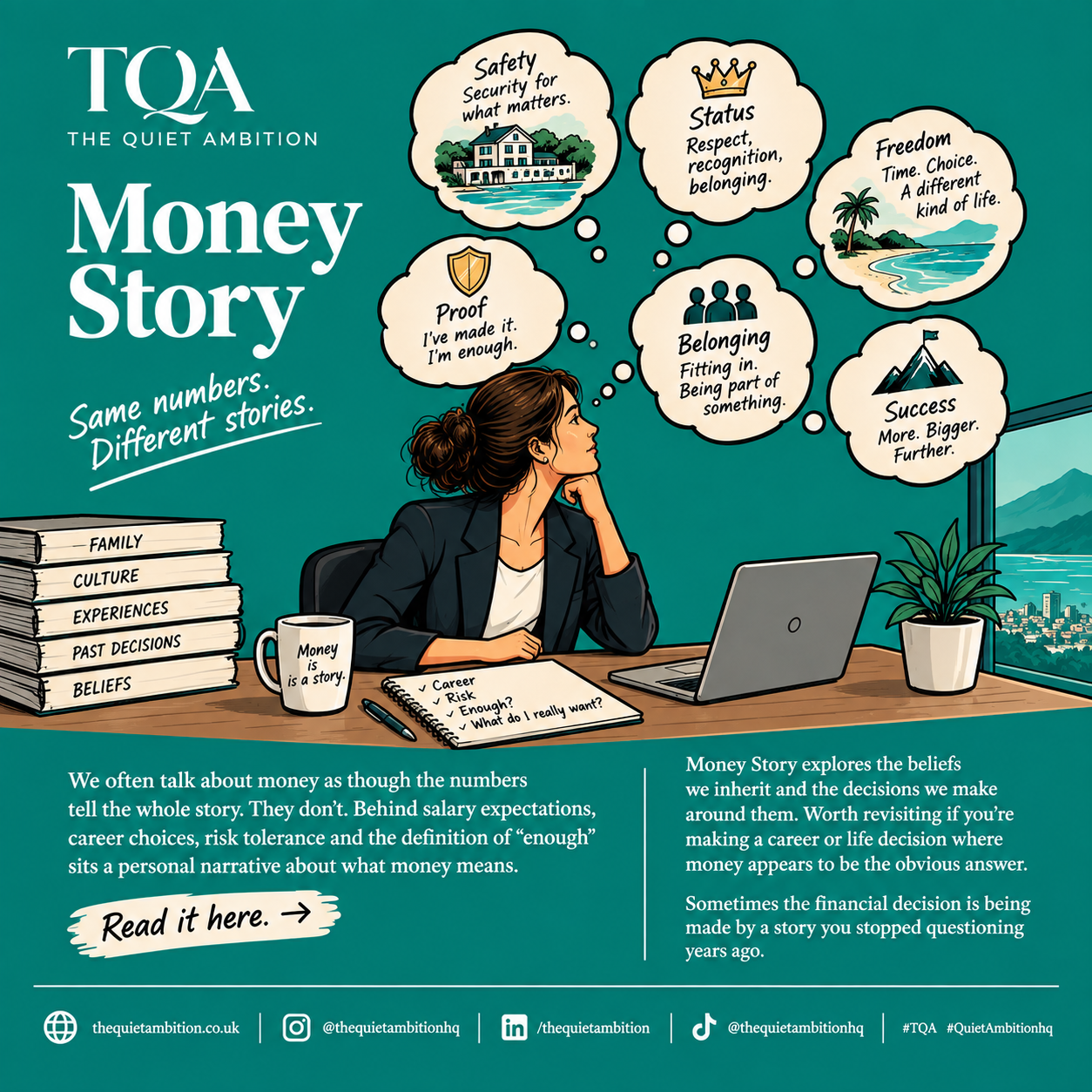
Most of us have our own version of that couch, a moment, or a slow accumulation of moments, when we first understood what money meant in the house we grew up in. Almost none of us go back and look at it. We just keep living inside the conclusion, mistaking it for a personality trait rather than what it actually is; an old story still running in the background of every financial and professional decision we make now.
The Insight
Money doesn't just buy things.
It determines which choices you believe you're allowed to make.
That belief is rarely conscious, and it's almost never really about the number in the account. It's about what the number is standing in for, safety, proof, escape, control. Jan Koum's version of the story was written in a welfare office in Mountain View, California, where he stood in line with his mother for food stamps as a teenager, newly arrived from Ukraine, sweeping the floors of a grocery store to help make rent.
In 2014, when Facebook agreed to buy WhatsApp, the company he'd co-founded; for $19 billion, Koum didn't sign the deal in a boardroom. He drove to that same disused welfare office and signed it on the door. He didn't need to do that. He could have simply become wealthy and moved on. Going back to the exact site of the original story, and rewriting what it was allowed to mean, was the real transaction. That's the part most of us skip. We chase the number and assume the story will resolve itself once we hit it. It usually doesn't, because the story was never really about the number.
The Quiet Disconnect
Here's the gap; ask a room full of accomplished professionals what drives them, and almost none will say money. They'll say standards, impact, legacy and they'll mean it, because by the time someone is running a company or a career people admire, the original story has long since dressed itself up as ambition. But underneath the language of excellence, a much older architecture is often still deciding what "enough" is allowed to mean.
Warren Buffett is the clearest possible counter-example. His salary at Berkshire Hathaway has been $100, 000 a year for more than 4 decades, unchanged, by his own request, while the company he runs is worth close to a trillion. He isn't underpaide simply never needed a rising salary to prove the story was working, because his wealth was never built to answer that question in the first place. Most people's relationship with money is still, quietly, trying to answer a question that was asked of them decades ago. Buffett settled his early and moved on.
The Quiet Choice
There are 2 ways to carry a money story;
1). Let it run unexamined to keep proving a childhood equation right or wrong for the rest of your life, mistaking the compulsion for character.
1). Go back and look at it: what did money mean in the house you grew up in, and is that still the truth you're organising your career around.
This isn't a call to want less. It's a call to find out whether what you want is actually yours.
The Quiet Rebellion
The rebellious act here isn't frugality, and it isn't ambition either. It's ownership, not just of assets, but of the terms.
In 2019, Taylor Swift's master recordings the original studio versions of her first 6 albums, the actual audio behind every song she'd ever released, were sold to a company she didn't choose, without her getting the chance to buy them herself. Most artists in that position take the payout attached to the situation and move on; the masters are gone, and that's simply how the industry works. Swift didn't. Rather than accept that someone else would always hold the originals, she spent the next 4 years re-recording those same 6 albums from scratch "Taylor's Version" until the new recordings outperformed the old ones on the charts and made the originals commercially irrelevant. In 2025, she went further and bought the actual masters back outright, writing to fans that she had "never owned until now" the art she'd dedicated her life to.
She didn't need to do any of that, the royalty checks would have kept arriving either way. Spending years rebuilding what she already owned artistically, just to hold the paperwork too, was never really about the money the re-recordings would generate. It was about refusing to let someone else's ledger decide what her own work was allowed to mean.
That's the quiet rebellion available to anyone, at any income: stop asking only for more, and start asking who actually holds the terms of what you've built.
The Quiet Beginning
The beginning isn't the payoff. It's the decision, made long before there's any proof it will work, that the story gets edited now rather than inherited forever. For Schultz, it was a policy. For Koum, it was a doorframe. For Swift, it was 4 years of re-recording work nobody was making her do. None of them waited to feel differently about money before they acted differently on it, the feeling caught up afterward.
The Quiet Ambition Exercise
Set aside 20 minutes this week and write down honest answers, not in your head, on paper.
What did money mean in the house you grew up in: safety, shame, status, silence, or something else entirely?
What is the earliest specific memory you have involving money, and what did you conclude from it at the time?
If you already had enough to feel completely safe, what would you still feel compelled to prove, and to whom?
In your current work, are you being paid, or do you own something? What would it take to move one step toward the second?
The Quiet Mantra
The story was written before you could read. You're allowed to edit it now.
The Quiet Reflection
None of these 4 people solved their money story by becoming rich. Schultz was already successful when he still described the shame of that afternoon as something "burned into" him. The story doesn't dissolve on contact with wealth. It has to be found and read on purpose, or it keeps making the decisions for you long after it's stopped being true.
The Quiet Conversation
What's the earliest thing you remember believing about money and is it still true?
Stories referenced: Howard Schultz (Pour Your Heart Into It; ASU commencement address, 2017); Jan Koum (Forbes, Parmy Olson, 2014/2019); Warren Buffett (Berkshire Hathaway proxy statements, 2004–2025); Taylor Swift (public statements, 2019–2025; NBC News, Today, Berkeley Technology Law Journal reporting on the Scooter Braun masters dispute).
Until next time,
Stay ambitious. Stay intentional.
With love, Caroline H. Founder #TheQuietAmbition #TQA
If this landed somewhere deep and you're ready to do the real work, I have a limited number of coaching and workshops spots open this month → Book a complimentary 30-minute Clarity Call [link in comments]. No pressure. Just conversation, insight, and clarity.
#TheQuietChoice : Don't React to Every Opportunity. Create space to hear yourself think.
#TheQuietConversation : Every issue ends here, but the conversation doesn't have to my inbox is always open…. get in touch.
#TheQuietCircle : Come join our community share ideas, ask questions and explore.
[links in comments]
© 2026 All rights reserved. No part of this newsletter may be reproduced, distributed, or transmitted without prior written permission from #TQA or The Quiet Ambition via Author Caroline H. at The Quiet Ambition @quietambitionhq | Building a life that leads to more life and Clarity & Alignment | The Quiet Ambition Practice @quietambitionhq
➕Follow Caroline H. for more insights.
© The Quiet Ambition · 2026