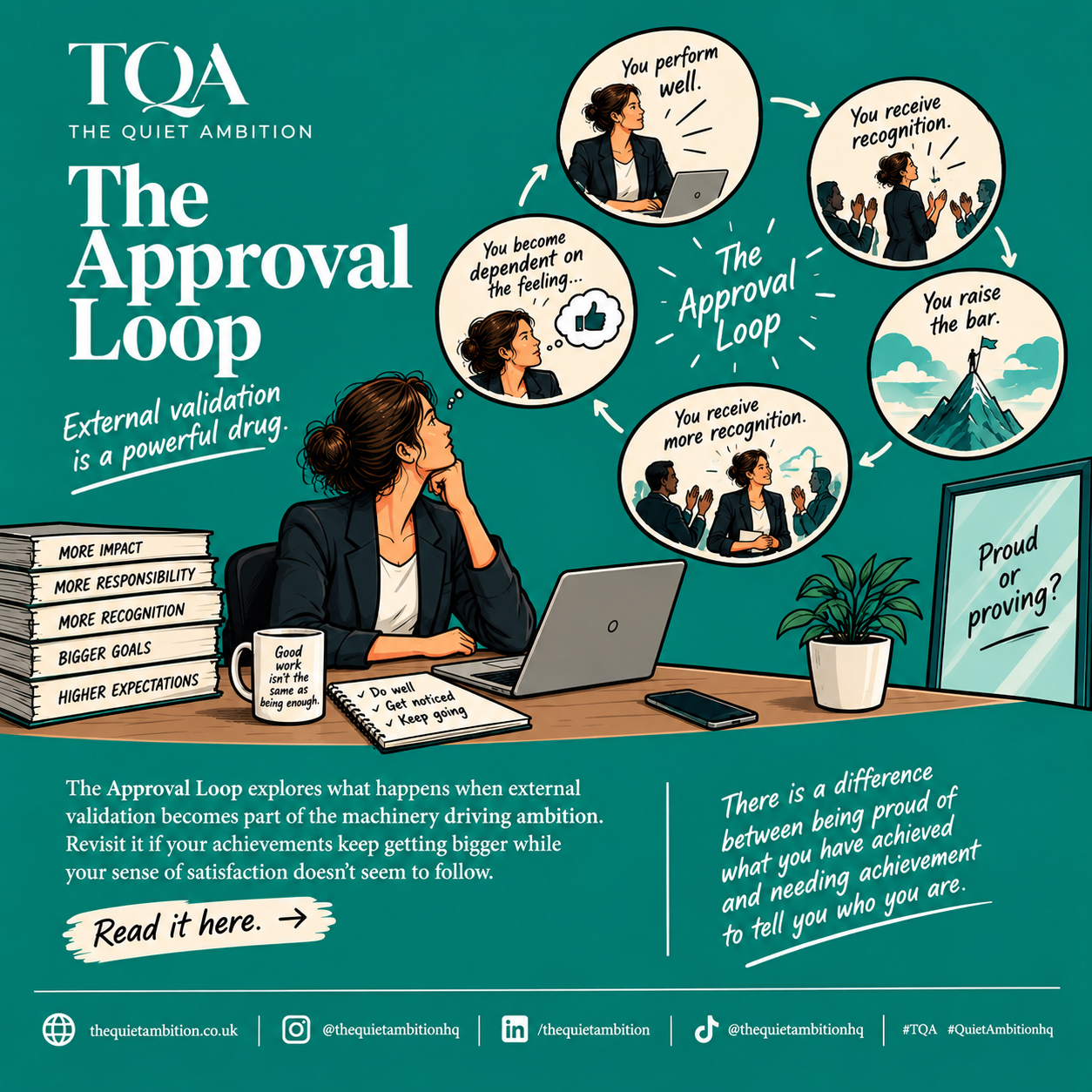
The Approval Loop. Issue #14
Season Two: The Architecture of Freedom.
Act I - Reckoning
The Quiet Story
What if the person you're still trying to impress hasn't been watching for years?
In her memoir Finding Me, Viola Davis describes a version of herself she learned to hide before she'd even left drama school. At Juilliard, she has said, the real Viola; too loud, too Black, too much, embarrassed her. So she left that version of herself somewhere on the subway most mornings and brought out a smaller, safer one instead: the one the room could accept. It took decades, an Oscar, an Emmy, and a memoir written in her own unpolished voice to finally stop editing herself down to size. Davis has been direct about what that cost her: liberation, she writes, only arrived once she stopped chasing validation from outside herself and started finding worth in something that didn't require an audience's vote.
That is the shape of the approval loop. Not a single failure of confidence, but a habit built early and rewarded often enough that it starts to feel like character rather than performance.
The Insight
Approval is powerful precisely because it disguises itself as identity. You don't experience it as I need them to approve of me. You experience it as this is simply who I am. I'm the reliable one, the high achiever, the person who doesn't disappoint people, the one who can be counted on to want the promotion, take the call andhold the standard.
By the time approval has calcified into self-description, you are no longer trying to earn anyone's good opinion. You are defending a version of yourself that once earned it, which is a much harder habit to notice, and a much harder one to put down.
The Quiet Disconnect
Here is the part that rarely gets said plainly: the audience you built that performance for is very often gone. The boss who made praise feel scarce may have left the company years ago, the parent who was hard to satisfy may have softened, or passed, or simply stopped keeping score the way you still are. The industry standard you mastered has usually moved on to a new one.
Psychologists have a term for a related pattern in adolescence: the "imaginary audience," coined by developmental psychologist David Elkind, the conviction that everyone is watching and judging, when in practice almost no one is paying nearly as much attention as it feels like they are. Cornell psychologist Tom Gilovich later measured the adult version of this directly: in one well-known study, people wearing a mildly embarrassing T-shirt guessed that half the room would remember it. The real figure was closer to a quarter. We are, it turns out, each the only person still taking attendance at our own performance.
The uncomfortable question that follows is simple: who would I be if nobody I was trying to impress could see what I did next?
The Quiet Choice
Not everyone answers that question the same way, and the difference is instructive.
In July 1965, Bob Dylan walked onto the stage at the Newport Folk Festival, plugged in an electric guitar in front of an audience that had spent two years building him into the acoustic voice of a movement, and played anyway. He was booed through the set. Pete Seeger reportedly wanted to cut the power cable. Dylan kept playing. He didn't leave the audience, he simply stopped auditioning for their previous verdict of who he was supposed to be.
Contrast that with Michael Jordan's 2009 Hall of Fame induction speech, delivered at the exact moment his greatness required no further proof to anyone. Rather than accept the induction, he spent much of it re-litigating decades-old slights: a high school coach who'd chosen another player over him, a college teammate, rivals who'd long since retired. He even flew in the man who'd made varsity ahead of him as a teenager, so the room could watch him win the argument one more time. One Hall of Famer described it privately as a man "still standing there trying to settle scores." The doubters Jordan was performing for had stopped watching some had stopped competing, some had simply moved on with their lives, years before he ever took that stage.
Both men had earned the right to stop performing. Only one of them did.
The Quiet Rebellion
The rebellion, when it comes, is rarely dramatic. It doesn't look like a resignation letter or a public reinvention. It looks like declining to explain a decision to someone who was never entitled to the explanation in the first place. It looks like letting a choice go unphotographed, unannounced, and unjustified. It looks like tolerating someone's mild disappointment instead of managing it into agreement.
It is, in other words, retiring from an audience that never actually bought a ticket.
The Quiet Beginning
Davis eventually got there too. Years after Juilliard, playing Rose in Fences, she has spoken about no longer performing a palatable version of grief and anger for the camera, simply telling the truth of the character and letting the work stand. That performance won her the Oscar. The approval came, in the end, from doing the opposite of chasing it.
That is usually how it goes, not the absence of ambition, but ambition with a different center of gravity; no longer organised around will this impress them, but around will this still be true in ten years, when they've stopped watching entirely.
The Quiet Ambition Exercise
Before your next significant decision, ask yourself two questions in order.
1) if nobody I know could ever find out I made this choice, would I still make it? If the answer changes depending on who's watching, that's worth sitting with.
2) whose approval am I actually trying to earn right now? Name the person specifically, not "people," not "the industry," an actual name. Then ask honestly whether they are still asking you for what you're still trying to give them.
Most of the time, the demand stopped coming from them a long time ago.
The Quiet Mantra
The audience left the room years ago. I'm the one still performing.
The Quiet Reflection
Freedom, in this sense, isn't the absence of an audience. It's noticing that the room has been empty for a while, and choosing what you want to do now that no one's left to clap.
The Quiet Conversation
Whose approval have you outgrown the need for, but haven't yet told yourself you don't need it anymore?
---
If the approval loop sounds less like a metaphor and more like your Tuesday, a Spark Session is a place to name whose approval you're actually still chasing, and a limited number of workshop dates are opening this fall for ambitious professionals ready to do that work properly. [Link in first comment.]
♻️ If this loop sounds familiar, repost it for someone still performing for a room that emptied out years ago.
🔔 Follow The Quiet Ambition for more on the architecture of a life built on your own terms, not an audience's applause.
Story references: Viola Davis, "Finding Me" (2022); Bob Dylan at the Newport Folk Festival, July 25, 1965; Michael Jordan, Basketball Hall of Fame induction speech, September 2009; David Elkind's "imaginary audience" theory of adolescent egocentrism; Thomas Gilovich et al., "The Spotlight Effect in Social Judgment," Journal of Personality and Social Psychology (2000).
#TheQuietAmbition #ApprovalLoop #ArchitectureOfFreedom #ClarityAndAlignment #QuietAmbitionCircle
Until next time,
Stay ambitious. Stay intentional.
With love, Caroline H. Founder #TheQuietAmbition #TQA
If this landed somewhere deep and you're ready to do the real work, I have a limited number of coaching and workshops spots open this month → Book a complimentary 30-minute Clarity Call [link in comments]. No pressure. Just conversation, insight, and clarity.
#TheQuietChoice : Don't React to Every Opportunity. Create space to hear yourself think.
#TheQuietConversation : Every issue ends here, but the conversation doesn't have to my inbox is always open…. get in touch.
#TheQuietCircle : Come join our community share ideas, ask questions and explore.
[links in comments]
© 2026 All rights reserved. No part of this newsletter may be reproduced, distributed, or transmitted without prior written permission from #TQA or The Quiet Ambition via Author Caroline H. at The Quiet Ambition @quietambitionhq | Building a life that leads to more life and Clarity & Alignment | The Quiet Ambition Practice @quietambitionhq
➕Follow Caroline H. for more insights.
© The Quiet Ambition · 2026