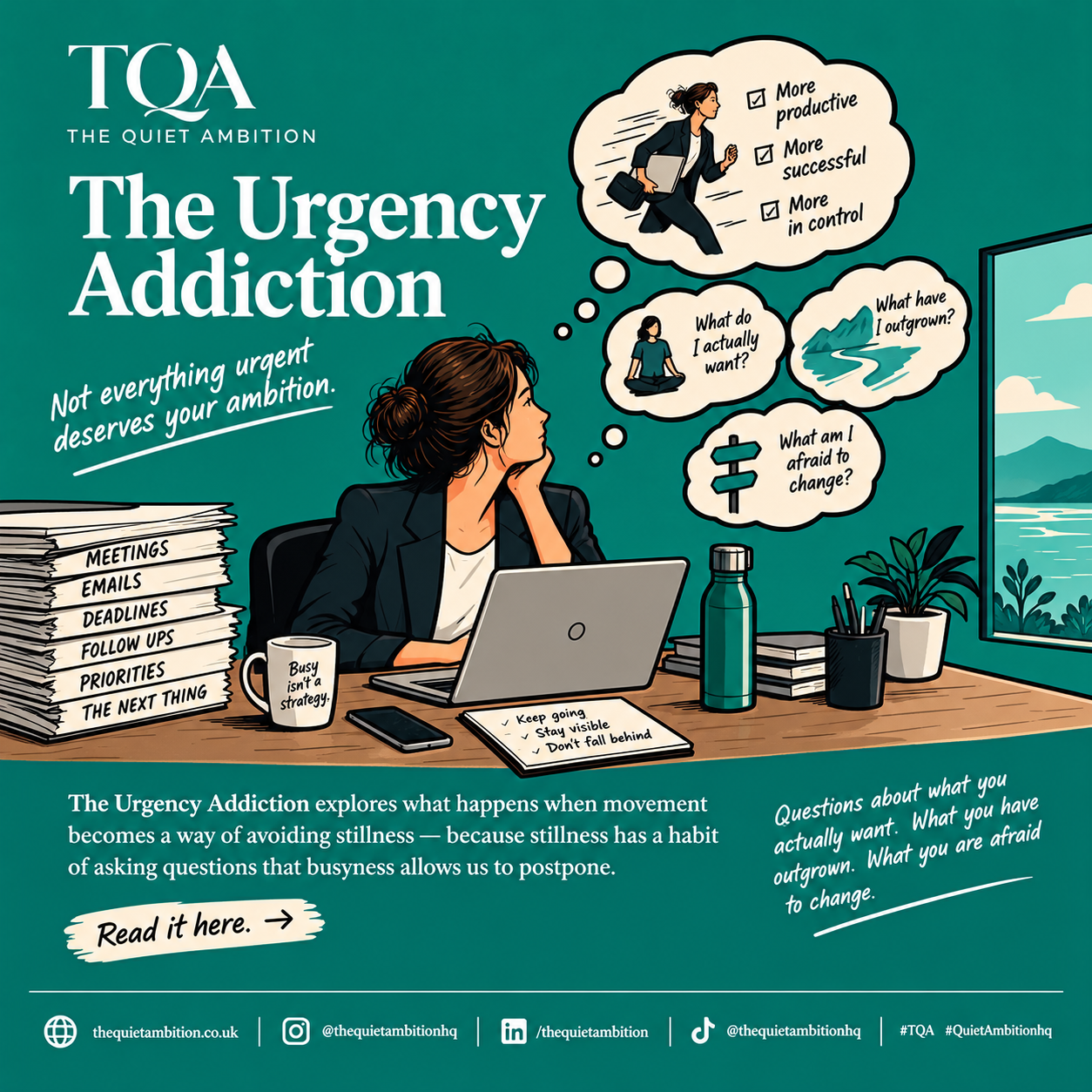
The Urgency Addiction. Issue #13
Season Two: The Architecture of Freedom.
Act I - Reckoning
Theme line: Constant urgency is often avoidance of stillness, not a response to real demands.
The Quiet Story
Picture the version of competence most of us were trained to perform: the inbox cleared before breakfast, the reply sent within minutes, the calendar packed edge to edge with no visible seam. It looks like command. It reads as discipline. Most of it is neither.
Jeff Bezos built one of the most demanding companies on earth, and yet by his own account his mornings are unhurried on purpose. He reads the newspaper, drinks coffee, talks to his family, and refuses to schedule anything mentally difficult before 10am. He has called this puttering, and he has said plainly that he is not as productive in those hours as people assume, because he believes in wandering. The meetings that follow are deliberately allowed to run long and go off-script, because he has found that the useful thinking happens in the mess, not in the rush to close the agenda. For a man running a company built on speed, the protection of unhurried time is not an indulgence. It is the mechanism.
The Insight
There is a name for the pull most of us feel toward the ticking clock over the better task. Researchers Meng Zhu, Yang Yang, and Christopher Hsee ran a series of experiments and found that people will consistently choose a lower-value task with a short deadline over a higher-value task with no deadline at all, even when every rational explanation for that choice has been removed. They called it the mere urgency effect. The clock itself, stripped of any reason to obey it, still wins. Deadline pressure narrows attention onto the gap between now and the cutoff, and in that narrowing, the question of whether the task was worth doing in the first place quietly disappears.
This is not a time-management flaw. It is a wiring flaw, and it explains why so many capable people spend their best hours on the loudest task rather than the truest one.
The Quiet Disconnect
Somewhere along the way, busy became a stand-in for worthy. Brené Brown, who has spent 2 decades researching shame and vulnerability, named this directly: she calls perpetual busyness one of the most common numbing strategies people reach for, a way of staying so occupied that the truer, harder questions about a life never quite catch up. The urgency isn't manufactured by the inbox. It's manufactured by what the stillness would otherwise force into view.
That's the disconnect worth sitting with. The urgent task rarely feels optional in the moment. But look closely enough, across enough weeks, and a pattern tends to surface: the same person, the same crisis-shaped hours, the same unreachable sense of catching up. If the fire never quite goes out, it may not be a fire. It may be fuel someone keeps adding.
The Quiet Choice
Not everyone who runs a demanding career has made peace with slowness, but a few have made it structural. Bill Gates, twice a year, disappears into an isolated cabin for seven days with no visitors, no calls, and stacks of unread papers. He calls it Think Week, and he has credited it with some of Microsoft's most consequential strategic turns, including the 1995 memo that redirected the company toward the internet. Gates isn't resting during that week. He is reading up to eighteen hours a day. But he is doing it away from the machinery of urgency, on a timeline nobody else controls.
The choice underneath both examples is the same one: deciding, deliberately and repeatedly, that the most important thinking will not happen inside the current of demands — it has to be built outside it, on purpose, before the current can claim the time first.
The Quiet Rebellion
There is something quietly defiant about protecting unstructured hours inside a culture that treats busyness as proof of value. It reads, to most colleagues, as a risk. It reads, to the person doing it, as the only way the good decisions ever get made. Rebellion, here, doesn't look like refusal. It looks like a closed calendar and an open morning.
The Quiet Beginning
Freedom from urgency addiction rarely starts with a cabin in the woods. It starts smaller, with noticing, just once, that a task felt urgent and turned out not to be. That single gap, seen clearly, is usually enough to loosen the grip
Look at tomorrow's calendar and ask two questions of each item: what happens if this waits three days, and what am I avoiding by making sure it doesn't have to. Sit with whatever answer arrives before rearranging anything. The exercise isn't about clearing the calendar. It's about seeing which of its urgencies were ever real.
The Quiet Ambition Exercise
Look at tomorrow's calendar and ask two questions of each item: what happens if this waits three days, and what am I avoiding by making sure it doesn't have to. Sit with whatever answer arrives before rearranging anything. The exercise isn't about clearing the calendar. It's about seeing which of its urgencies were ever real.
The Quiet Mantra
Urgency is a feeling. It is not always a fact.
The Quiet Reflection
What would this week look like if you trusted that the important things wouldn't disappear the moment you stopped rushing toward them?
The Quiet Conversation
Where in your life has "urgent" quietly become a synonym for "avoided"? Drop it in the comments — I read every one.
♻️ If this named something you've felt but never said out loud, repost it, someone in your network is running on the same fumes.
🔔 Follow The Quiet Ambition for more on the architecture beneath the achievements no one questions.
Sources:
- Jeff Bezos — "puttering," protecting mornings, no meetings before 10am, "high-IQ meetings" before lunch, the 5pm cutoff: Bezos in conversation with David Rubenstein, Economic Club of Washington, D.C., September 2018 (full transcript at economicclub.org); also in Invent & Wander: The Collected Writings of Jeff Bezos (Harvard Business Review Press, 2020). His preference for meetings that "wander" and run long: Lex Fridman Podcast, December 2023, as reported by CNBC Make It, April 2024.
- Bill Gates — Think Week practice (twice yearly, isolated cabin, up to 18 hours a day reading) and its link to the 1995 "Internet Tidal Wave" memo: CNBC Make It, "Bill Gates took solo 'think weeks' in a cabin in the woods," July 2019, citing original Wall Street Journal reporting. The memo itself: internal Microsoft memo dated May 26, 1995, reprinted in full by WIRED (2010) and covered by Fast Company and CNBC.
- The Mere Urgency Effect — Zhu, M., Yang, Y., & Hsee, C. K. (2018). "The Mere Urgency Effect." Journal of Consumer Research, 45(3), 673–690. https://doi.org/10.1093/jcr/ucy008
- Brené Brown — "crazy-busy" as a numbing strategy: Daring Greatly: How the Courage to Be Vulnerable Transforms the Way We Live, Love, Parent, and Lead (Gotham Books, 2012)
Until next time,
Stay ambitious. Stay intentional.
With love, Caroline H. Founder #TheQuietAmbition #TQA
If this landed somewhere deep and you're ready to do the real work, I have a limited number of coaching and workshops spots open this month → Book a complimentary 30-minute Clarity Call [link in comments]. No pressure. Just conversation, insight, and clarity.
#TheQuietChoice : Don't React to Every Opportunity. Create space to hear yourself think.
#TheQuietConversation : Every issue ends here, but the conversation doesn't have to my inbox is always open…. get in touch.
#TheQuietCircle : Come join our community share ideas, ask questions and explore.
[links in comments]
© 2026 All rights reserved. No part of this newsletter may be reproduced, distributed, or transmitted without prior written permission from #TQA or The Quiet Ambition via Author Caroline H. at The Quiet Ambition @quietambitionhq | Building a life that leads to more life and Clarity & Alignment | The Quiet Ambition Practice @quietambitionhq
➕Follow Caroline H. for more insights.
© The Quiet Ambition · 2026